Where Is the Line? Federal Use of Force and the Absence of Congressional Oversight
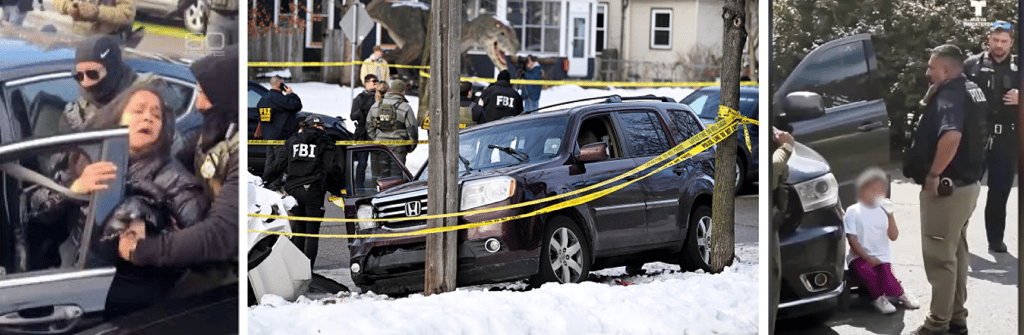
Renée Good, a 37-year-old mother and poet, dropped her 6-year-old son at school on the morning of January 7th. Minutes later, she was shot and killed by a federal immigration agent on a Minneapolis street.
1/22/20266 min read

Where Is the Line? Federal Use of Force and the Absence of Congressional Oversight
Renée Good, a 37-year-old mother and poet, dropped her 6-year-old son at school on the morning of January 7th. Minutes later, she was shot and killed by a federal immigration agent on a Minneapolis street.
Video evidence contradicts federal claims that she tried to run over the agent. The agent who killed her has not been arrested. He has not been charged. Federal authorities have not even publicly released his name.
The investigation into her death has been seized by the FBI, which blocked Minnesota's state investigators from accessing any evidence.
A 5-year-old boy named Liam was used as "bait" by federal agents to arrest his father. Both were detained in their driveway after returning home from preschool. Both were sent 1,200 miles away to a Texas detention center. His middle-school brother came home to find his father and little brother gone, his mother terrified.
Four children from one Minnesota school district have been detained and shipped to Texas facilities with documented abusive conditions.
A 6-month-old infant was hospitalized after federal agents fired tear gas during a protest. The family was simply driving home from their child's athletic event when the gas hit their car.
Federal immigration agents have opened fire at least 17 times since Trump's second term began. Eleven people have been shot since September 2025. Four are dead. The majority were shot in moving vehicles, a tactic law enforcement experts have spent decades trying to eliminate.
Protesters have been met with tear gas, pepper spray, and crowd-control munitions. Two people were blinded by "non-lethal rounds" in California. Federal agents have deployed chemical weapons in residential neighborhoods. Children have been caught in the crossfire.
Official explanations have shifted. President Trump claimed Renée Good "viciously ran over" the agent and that the agent was recovering in the hospital. Video shows her car turning away from him. Minneapolis Mayor Jacob Frey watched the footage and called the federal narrative "bullshit."
DHS Secretary Kristi Noem labeled Renée Good a "domestic terrorist." She was a U.S. citizen with no criminal record who had just dropped her child at school.
Facts have been deliberately obscured. The FBI took sole control of the investigation and denied Minnesota authorities access to evidence, witness interviews, and crime scene materials. "You don't cut out investigators unless you're hiding something," said Democrats on the House Homeland Security Committee.
At what point does the absence of oversight constitute a constitutional crisis?
The Constitution Requires Oversight
The Constitution does not permit federal agents to operate beyond institutional restraint.
It does not allow the use of lethal force without accountability mechanisms.
It does not tolerate the exercise of state power against civilians, families, or children without oversight.
And it assigns Congress the duty to provide that oversight.
When federal enforcement actions result in civilian deaths, child detentions, and the use of force against communities, the constitutional framework requires immediate congressional investigation.
Silence in the face of this conduct is not neutrality. It is institutional abdication.
This Is Not Law Enforcement as Usual
No one is arguing that immigration laws cannot be enforced.
The issue is how they are enforced, who is being targeted, and whether oversight is functioning.
Federal power is supposed to be constrained by law, transparency, and congressional accountability. When agents kill citizens, detain 5-year-olds, fire tear gas that hospitalizes infants, and escalate force against communities, the constitutional system is designed to trigger immediate congressional investigation.
That has not happened.
Instead, Congress has actively declined to exercise oversight authority.
Congressional Authority That Exists
What Congress Could Do:
The House Oversight Committee has jurisdiction over DHS operations and the authority to subpoena documents and testimony.
When Democratic Representative Ayanna Pressley moved to subpoena DHS records and footage of Renée Good's killing, the committee could have approved the motion.
The House Judiciary Committee has jurisdiction over the Department of Justice and FBI. It has the authority to investigate why the FBI blocked state investigators from accessing evidence.
The House Homeland Security Committee has direct oversight authority over DHS and ICE operations. It can hold hearings, issue subpoenas, and investigate use-of-force incidents.
Both chambers have the constitutional authority to impeach officials who obstruct oversight or violate constitutional rights.
What Congress Actually Did
When given the opportunity to subpoena records and investigate Renée Good's killing, every single Republican member of the House Oversight Committee voted against it.
Articles of impeachment against DHS Secretary Kristi Noem have been introduced with 70+ signatures from members of Congress. They cite obstruction of congressional oversight, violations of due process, and warrantless arrests of American citizens.
They remain buried by Republican leadership. No hearings have been scheduled.
When Senator Tina Smith called for congressional oversight of ICE operations and demanded the FBI allow state investigators access to evidence, leadership did not act.
When both Democratic and Republican senators expressed concern about the tactics being used, no oversight hearings were scheduled.
The only investigation happening is controlled entirely by the administration being investigated.
The FBI reports to the Department of Justice. The Department of Justice reports to the President. The President has publicly defended the shooting and attacked those calling for accountability.
This represents the absence of independent oversight.
The Documented Pattern
This is not an isolated incident.
Federal immigration agents have shot 11 people since September 2025. Four are dead. The documented pattern shows: agents fire into moving vehicles, claim self-defense, modify their accounts when video contradicts them, and face no institutional consequences.
In 2025, 32 people died in ICE detention—the deadliest year in more than two decades. There are already four documented deaths in the first three weeks of 2026.
Immigration detention has increased 78% from 2024 to 2025. The Trump administration has systematically dismantled the federal watchdog responsible for investigating civil rights violations at DHS. Congressional inspections of detention facilities have been restricted.
Stephen Miller told ICE agents in October that they have "federal immunity." Vice President JD Vance falsely claimed the agent who killed Renée Good has "absolute immunity."
That is not how the law works. But it is how power operates without oversight.
What Congressional Oversight Requires
The oath members of Congress swore is explicit:
"I do solemnly swear that I will support and defend the Constitution of the United States against all enemies, foreign and domestic; that I will bear true faith and allegiance to the same."
That oath does not include exceptions for party loyalty. It does not include exceptions for political pressure. It does not include exceptions for presidential demands.
When a federal agent kills a U.S. citizen, Congress has constitutional authority to investigate.
When children are detained and shipped to facilities 1,200 miles from home, Congress has constitutional authority to intervene.
When infants are hospitalized from chemical weapons deployed in residential neighborhoods, Congress has constitutional authority to investigate use-of-force policies.
When peaceful protesters are tear-gassed, pepper-sprayed, and shot with crowd-control munitions for exercising their First Amendment rights, Congress has constitutional authority to provide oversight.
The authority exists. The duty is clear. The oversight has not been exercised.
What This Documents
This is not a failure of knowledge. It is a documented choice.
This is not a lack of information. It is a documented refusal to act.
Congress has the constitutional power to investigate. They voted not to.
Congress has the constitutional power to demand accountability. They chose not to exercise it.
Congress has the constitutional power to fulfill its oversight duty. They declined to do so.
The Constitutional Framework When Oversight Fails
Oversight did not fail because Congress lacked power.
Oversight failed because Congress chose not to exercise it.
When this happens, the Constitution does not self-correct.
The framers designed a system where each branch checks the others. When Congress declines to check executive power, that institutional mechanism disappears.
Courts often decline to intervene in political questions or arrive too late to prevent harm.
When institutional oversight fails, informed citizenship becomes the remaining constitutional safeguard.
Why Constitutional Documentation Matters
This is why constitutional documentation matters.
Because when federal power crosses documented lines and Congress declines to investigate, the factual record must be preserved.
The facts:
Renée Good's 6-year-old son will grow up without his mother
A 5-year-old boy sits in a Texas detention center 1,200 miles from home
An infant was hospitalized from tear gas fired into a residential neighborhood
Four children from one school district have been detained and deported
The agent who killed Renée Good has not been charged, and his name has not been publicly released
The documented congressional response:
Congress had the power to investigate. Every Republican on the Oversight Committee voted to block it.
Congress had the power to subpoena evidence. They declined to exercise it.
Congress had the power to hold hearings. They chose not to schedule them.
When oversight mechanisms fail and oaths are not honored, constitutional documentation ensures the record remains complete.
When citizens evaluate whether their representatives are exercising constitutional authority, they need access to verified facts:
Who had oversight authority
What actions they took or declined to take
What the documented consequences were
Constitutional documentation provides that factual foundation for informed citizenship.
The Question That Remains
At what point does the absence of oversight constitute a constitutional crisis?
When federal agents kill citizens without investigation?
When 5-year-olds are detained and transported 1,200 miles from home?
When infants are hospitalized from chemical weapons?
When Congress votes unanimously to block oversight?
The framers gave Congress the tools to prevent this.
Congress has chosen not to use them.
That choice is now part of the permanent record.
Support Constitutional Documentation
Fund Documentation Infrastructure →
Sources
Renée Good shooting: Minneapolis officials, video analysis (CNN, Reuters, AP), federal statements (DHS press conferences)
Child detentions: Court filings, Minnesota school district records, advocacy organization documentation
Use of force statistics: Congressional testimony, DHS data, investigative reporting (ProPublica, New York Times, Washington Post)
Congressional votes: House Oversight Committee records, articles of impeachment (Congressional Record)
Detention deaths: ICE detention statistics, Congressional Research Service reports
Federal immunity claims: Video of Stephen Miller address to ICE, Vice President Vance public statements
Last updated: January 28, 2026
CONSTITUTIONAL ACCOUNTABILITY NOW
CAN2026.org is an independent, nonpartisan public-accountability initiative documenting elected officials, candidates, elections, campaign finance, government actions, and constitutional oversight through verified public records. Contact: info@CAN2026.org
© 2026 CAN2026.org. All rights reserved.
Home | About | Government Record | Federal Agencies| U.S. Congress | FAQs | Funding | Contact Us | Privacy Policy Terms of Use
© 2026 Constitutional Accountability Now. All rights reserved.